Iberia launches the SAF Circle together with four large corporations to contribute to the use of SAF
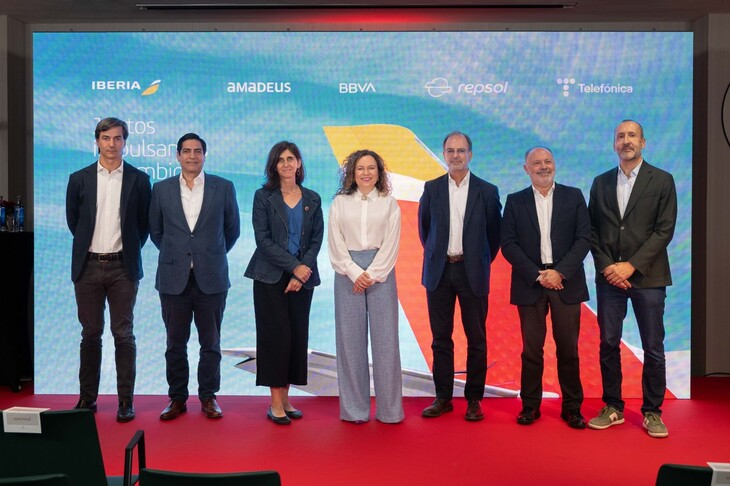
- Iberia launches the SAF Circle community, a corporate program with the objective of promoting the use of sustainable aviation fuels (SAF). It allows its customers to contribute to the reduction of part of the Scope 3 emissions generated in corporate travel and cargo transportation with Iberia, encouraging the use and development of sustainable aviation fuel
- Together with the airline, Amadeus, BBVA, Repsol and Telefónica form a community that seeks to contribute to the use of SAF fuel and promote the reduction of CO2 emissions to the atmosphere
- SAF (“Sustainable Aviation Fuel”, for its acronym in English), is the main alternative, together with fleet renewal, currently feasible to gradually decarbonize the aviation sector, since it can be used without modifying either aircraft engines or airport infrastructures
Today, Iberia presented the SAF Circle, an initiative aimed at promoting collaboration between different actors to progressively increase the use of sustainable aviation fuel (SAF). The objective is to make it easier for companies from different sectors to participate in this collective effort and to associate the use of SAF with part of the emissions derived from their business trips and freight transport (scope 3 emissions). These refer to emissions from your business trips and freight transport.
Los founding members of this project are four companies committed to sustainability and the reduction of their carbon footprint: Amadeus, BBVA, Repsol and Telefónica. These four corporations contribute to the reduction of part of the emissions generated in certain corporate trips and cargo flights operated by Iberia, encouraging the use of SAF in them. This involves the reduction of global emissions in the aviation sector, being the estimated reduction of between 10 and 30% in scope 3 emissions of companies operating with Iberia.
SAF Circle members will benefit from benefits such as corporate rewards, which provide access to improvements to Iberia's corporate loyalty program. The SAF Circle has three different tiers, so companies of all kinds can join. The companies participating in the alliance will be certified by the SAF used in airline travel. This SAF is certified in accordance with the sustainability criteria defined by the European Renewable Energy Directive.
The presentation was made María Jesús López Solás, Commercial Director, Network Development and Alliances at Iberia, and Diego Fernández, Director of Strategy, Transformation and Sustainability at Iberia. “We are very proud that these four large companies are joining Iberia to contribute to decarbonization through the use of SAF. We share a commitment to gradually moving towards decarbonization and we can only achieve this objective if we work together,” said Diego Fernández.
“A fundamental element of Amadeus's sustainability strategy is to take advantage of our knowledge and experience in the technology and travel sector, as well as our indirect contact with millions of travelers on a daily basis, to provide information on sustainability and accelerate the adoption of more sustainable trips,” he acknowledged. Lucas Bobes, Group Environmental Officer at Amadeus.
Leonardo Pereyra, Head of Direct Impact at Sustainability Area at BBVA mentions that “being part of alliances such as the SAF Circle is important to promote the energy transition and a more sustainable future. In addition, it allows us to go one step further in managing our carbon footprint while supporting decarbonization efforts in the aviation sector. A sector that we include in our decarbonization objectives in 2023, and that requires both the development of technologies and the union of companies and administrations to promote the use of sustainable fuels for aviation.”
Carlos Suárez, B2B and Commercial Aviation Director at Repsol: “the presentation of the SAF Iberia Circle is a significant step towards reducing the carbon footprint in the aviation sector. At Repsol, we are very happy to be part of this initiative that promotes the use of sustainable aviation fuels (SAF). Our renewable fuel production plant in Cartagena is a clear example of our commitment to innovation and sustainability. This plant, one of the most advanced in Europe, allows us to produce SAF, thus contributing to the decarbonization of air transport. With a production capacity of 250,000 tons per year, we are ready to meet the growing demand for sustainable fuels in the domestic and international markets. In short, Repsol will continue to collaborate with strategic partners such as Iberia to promote the use of SAF and reduce CO₂ emissions.”
“Meeting our commitment to achieve zero net emissions by 2040, including the value chain, implies more sustainable habits on the most diverse fronts, including corporate travel. Responsible digitalization involves a transformation both in large processes and in small actions. Although corporate travel only accounts for 2% of our global indirect CO₂ emissions (Scope 3), every ton counts. Joining Círculo SAF is also a way to contribute to our country's energy transition. This initiative combines two essential ingredients to promote real change: innovation and collaboration,” said Maya Ormazabal, Director of Environment and Human Rights at Telefónica.
What is the SAF?
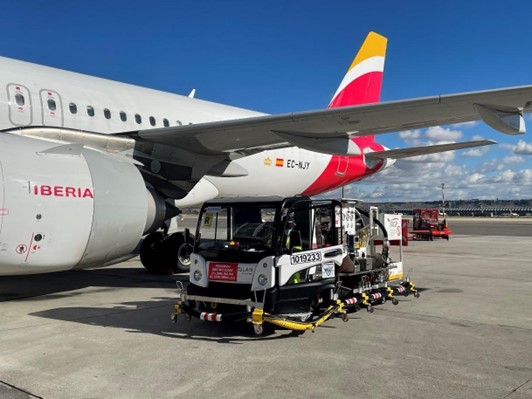
Sustainable aviation fuel (or SAF for its acronym in English: sustainable aviation fuels) is a type of fuel that can be obtained from agricultural or forestry waste in its biological version (BioSAF), or from renewable hydrogen and CO₂ captured from air (eSAF or synthetic SAF) or from industrial processes (recycled carbon fuels). Compared to traditional kerosene, SAF can reduce greenhouse gas emissions by around 80% in terms of life cycle, according to the European Union Aviation Safety Agency (EASA).
In the case of BioSAF, which is obtained from plant waste, the energy transition and the circular economy are also enhanced. The waste that serves as raw material for processing currently ends up, to a large extent, in landfills or disposed of on farms. A developed SAF industry would mean better management of this waste and its use as a resource.
The great advantage of the SAF is that it can be used without making any changes to either aircraft engines or airport infrastructure. Therefore, it is the currently viable alternative to reduce part of emissions in the aviation sector, together with the renewal of the fleet in which Iberia has also made a great effort in recent years.
Scope 3 emissions
Scope 3 emissions are indirect greenhouse gas emissions that come from supply chain activities outside the company's direct control. They include, but are not limited to, the production of raw materials, transportation, distribution, business travel and staff travel. These types of emissions are critical for all companies, since corporate travel and cargo transportation are inherent to their activity, especially those of large corporations.
(*) SAF” means “Sustainable Aviation Fuel” or “sustainable aviation fuel” as defined in Regulation (EU) 2023/2405 of the European Parliament and the Council, of October 18, 2023, on equal conditions for sustainable air transport. Therefore, sustainable aviation fuels are:
- synthetic aviation fuels: aviation fuels that are “renewable fuels of non-biological origin”, as defined in Directive (EU) 2018/2001 (art.2), that meet the life-cycle emission reduction threshold referred to in Article 29.bis paragraph (1) of that Directive and are certified in accordance with Article 30 of that Directive.
- aviation biofuels: as defined in Directive (EU) 2018/2001
- recycled carbon aviation fuels: aviation fuels that are “recycled carbon fuels”, as defined in Directive (EU) 2018/2001, that meet the lifecycle emission reduction threshold referred to in Article 29.bis.paragraph (2) of that Directive and are certified in accordance with Article 30 of that Directive.